Tuesday, 17 January 2012

Game Replay Value Case Study

Previously my tutor explained to me about game replay value to help me work out the structures and contents of my game. I understand the explanation well, but did not fully understand the process or the structure as I have not played and compare any games similar to my project. I found two interesting short games which will be used as a case study for game replay value as well as the design and content of both games. The games are: The King's League, and The First Hero.

The King's League link: http://www.kongregate.com/games/kurechii/the-kings-league

The First Hero link: http://www.kongregate.com/games/BeGamerCom/the-first-hero

Both are short games which lasts about 5 to 10 minutes each, or may be longer for The King's League.

The first game is called The King's League developed by Kurechii Studio. It is a point-and-click game which is about fighting in battles and get stronger to acclaim the king's throne. It has no story but has a goal in which is a non linear game. The interface is as follows:


 The King's League: Main page interface.


The colours used for this game are well researched. Purple is a royal colour, with some yellow colours used throughout the game and minor other colours which represents each characters well. The vector and overall design is very neat and minimal to avoid confusion as users play the game.


The King's League: Map and overall interface.


The map is simple yet detailed although not many players will notice much about it. The information are placed in comfortable positions at the top and bottom of the interface so that users can find information easily. Buttons and icons are well designed too.


The King's League: Instructions.

Text instructions are clearly written in a speech bubble layer, accompanied by visual instructions such as left-click mouse button. The different music used also suits different scenes.


 The King's League: Battle scene.


The battle scene is purely animation, and the character's training is crucial to decide who the winner is. (Users' characters are on the left) The background for battle scenes may be slightly dull as the focus are on the bar and the characters, but nevertheless is still very detailed. 


The second game is called The First Hero developed by BeGamerCom is another point-and-click game with a story. The story is about a hero traveling the ancient world and underworld to save his loved one. It has a very linear storyline with interesting but short gameplay. The interface is as follows:


The First Hero: Main page interface.


The visual design of the interface has a more chaotic feeling and the title's font is not suitable if compared to the visual. The colour suits the Greek theme especially seen in Greek design vases, but the realistic character in the background does not match the character in-game.


The First Hero: Map interface.


The visual design of this game is a mix of vector graphics, still images and textures. It has a very sepia-feel to portray an ancient time. The textures of the background enhances the effect of being 'old' or 'long time ago'. It is also solely animation while the boat or character is moving, except when clicking to close instructions.


 The First Hero: Instructions.

Text instructions are either direct or unclear at times, for example, not telling the users what to do. Users will have to figure out what and where to click in order to proceed the game. This is a form of mystery meat. Nevertheless, the instructions do not cause users to be frustrated as there are times, such as the picture above where users have to solve puzzles.


The First Hero: Character names.


Character names are according to Greek mythology characters and gods. But there are some name which are intentionally or unintentionally given by the developer that are misspelled. The picture above shows a three-headed dog Ceberus, which is renamed as Kerberos, and another example is with the Sphinx renamed as Sphynx.


The game replay value of The King's League is greater than The First Hero, meaning users will long to replay the game again at least once. Since there is no definite ending in The King's League, users can replay as a new game or continue with the settings and achievements of the previous game. On the other hand, The First Hero has a storyline in which users would understand upon finishing the game. Users will by then know what the story is about and how to proceed on, and that makes the game unlikely playable the second round.

In summary, the information about game replay value collected from both games are as follows but not restricted to:

- Games with greater replay value has more choices and varieties.
- It is normally non-linear or with more than one story. 
- Visual and audio design as well as game contents also affect the game replay value.
- Games should be more rewarding so that users will continue playing to get rewards. 
- Hidden or unlocked elements serves as a 'secret weapon' to make users play longer to unlock them.
- Games with greater replay value should not have a definite ending such as an ending with discontinues the entire story.


Wednesday, 11 January 2012

Project Critique and Tutorial 5

Today's tutorial solely focused on Action Scripts. These are among the issues and feedbacks for today's tutorial session:

- Bugs and glitches in the Action Script for the game are fixed and explained by tutor.
- Action Script can be simplified to ease programming. (sample demonstrated by tutor)
- Proceed with any graphics and animation.

Tuesday, 10 January 2012

Scene Design Refined

I had refined the colours and give some shadow and highlights to the scenes. Here are the scenes for the completed location of the game:


 Picture 1: Classroom.


 Picture 2: Friend's house.


 Picture 3: Home.


 Picture 4: Library.


 Picture 5: Mall.


 Picture 6: Park.


 Picture 8: Restaurant.


Picture 9: Playground.

Monday, 2 January 2012

The Simpsons Art Direction Referencing

After showing some of my friends and classmates the images I've done so far, most of them relate it to The Simpson's art style and think that I should reference from it more to polish up my graphics.

Link to image references: http://www.imdb.com/media/rm4114659584/tt0096697

Tuesday, 20 December 2011

Action Script Testing 1

A sample test using simple geometric shapes - rectangles to represent social/energy bars and circles to represent locations that users can click in the world map. The numbers on the right side of the bars are the percentage representation in numeric form.


Picture 1: Sample Action Script testing for social/energy bars and location in world map.

Friday, 16 December 2011

Project Critique and Tutorial 4

During my tutorial session, I've shown my scene designs and a little bit of Action Script I did with the help of Stezon Liew and William Siah. These are some comments and activities done in class:

- Scenes would need to refine to be more detailed.
- Scripting in class for: social/energy bar and clock.

Among some problem occurred in the Action Script for the clock and social/energy bars:

- Social/energy bar's length at first click decreases tremendously, but normal decrease after second click.
- Social/energy bar's numeric form would continue to increase after 100 and decrease below 0.
- Don't know how to script for clock's movement (when increasing the time for different activities).

Tuesday, 13 December 2011

Game Location-activity Chart 2

A new chart made after considering some suggestions from my tutors to ease my programming work later on.


Picture1 1: Game location-activity chart revised.


Scene Design Basic Colours


Finished all scene designs with the basic colours to show the mood and feel of the overall scene. Gradients and shadows will be added in, as well as different lighting for different times of the day.

Here are all the scenes of the game (excluding world map):


 Picture 1: Classroom.


 Picture 2: Friend's home.


 Picture 3: Home. 


 Picture 4: Library.


 Picture 5: Mall. (with unfinished poster and things on the shelves)


 Picture 6: Park.


 Picture 7: Playground. (with unfinished swing parts added in Flash for animation)


Picture 8: Restaurant.


Monday, 12 December 2011

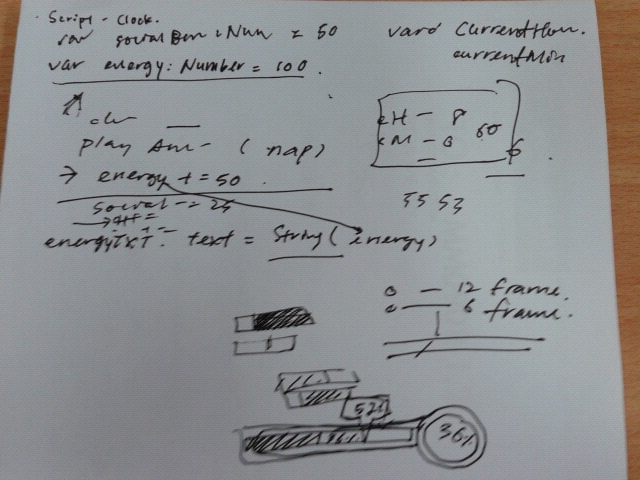
Action Script Aid by Tutor

This is part of the Action Script in which my tutor aid me with for my project. It's basically parts of the script for programming my social/energy bar and how my in-game clock would work.


Picture 1: Action Script tutorial written by the tutor.

Wednesday, 7 December 2011

Project Critique and Tutorial 3

This week I've shown a full interface design of a particular scene, with the elements such as the clock, social bar and energy bar. I also shown the activity-location chart, and below are the feedbacks and suggestions given today:

- Activity-location chart is much better than previous versions, activity duration can be in 10 or 15 minutes time interval to ease scripting process.
- Energy and social bar can be made to be more consistent in design.
- Look up interesting bar design in games for better idea and apply inspiration in current bar design. (looks a bit plain)
- May proceed to complete scenes and animation. And good start of finding Action Scripts. Test out Action Scripts too.